Timber Procurement and Demonstrators
Accelerate the use of mass timber in Ireland
Partners
Caris Consulting
Kosmos
The construction sector is responsible for 40% of Ireland’s CO2 emissions, with embodied carbon making up 14% of the total. While progress has been made in reducing operational carbon, embodied carbon remains largely unregulated. Ireland’s climate commitments require a 51% reduction in greenhouse gas emissions by 2030 and carbon neutrality by 2050, necessitating a shift towards sustainable materials like mass timber.
Waugh Thistleton Architects, Caris Consulting and Kosmos were appointed by the Irish Government’s Office of Public Works to examine how procurement policy and demonstrator projects could accelerate the adoption of mass timber in Ireland. The work formed part of the wider Timber in Construction Steering Group, which aims to adapt Ireland’s regulatory and policy framework to support sustainable, renewable materials while maintaining high standards of building and property safety and strengthening the domestic timber supply chain.
The research examined the barriers to procuring MET through stakeholder engagement, industry expertise and an assessment of how regulation is applied in practice.
Three key barriers emerged:
- Policy gaps - a lack of clear life cycle and embodied carbon targets hinders innovation and progress in reducing the carbon impact of construction.
- Industry challenges - supply chain limitations, certification complexities, and procurement inefficiencies, as well as a lack of technical knowledge can all discourage MET uptake.
- Regulatory constraints - inconsistent enforcement coupled with unnecessarily conservative regulatory approaches limit market confidence.
These barriers affect both public and private sector clients. Greater certainty is needed across policy, procurement, regulation and insurance to give the industry confidence to invest in building with mass timber.
The report identifies three priorities for accelerating adoption:
- Clear policy for low carbon construction - establish embodied carbon targets, strengthen procurement frameworks and create incentives to boost market confidence.
- Industry capacity building - improve knowledge and skills, strengthen supply chains and use demonstrator projects to build confidence and share learning.
- Regulatory reform - establish consistent approval pathways, strengthen technical expertise and enable greater use of performance-based approaches.
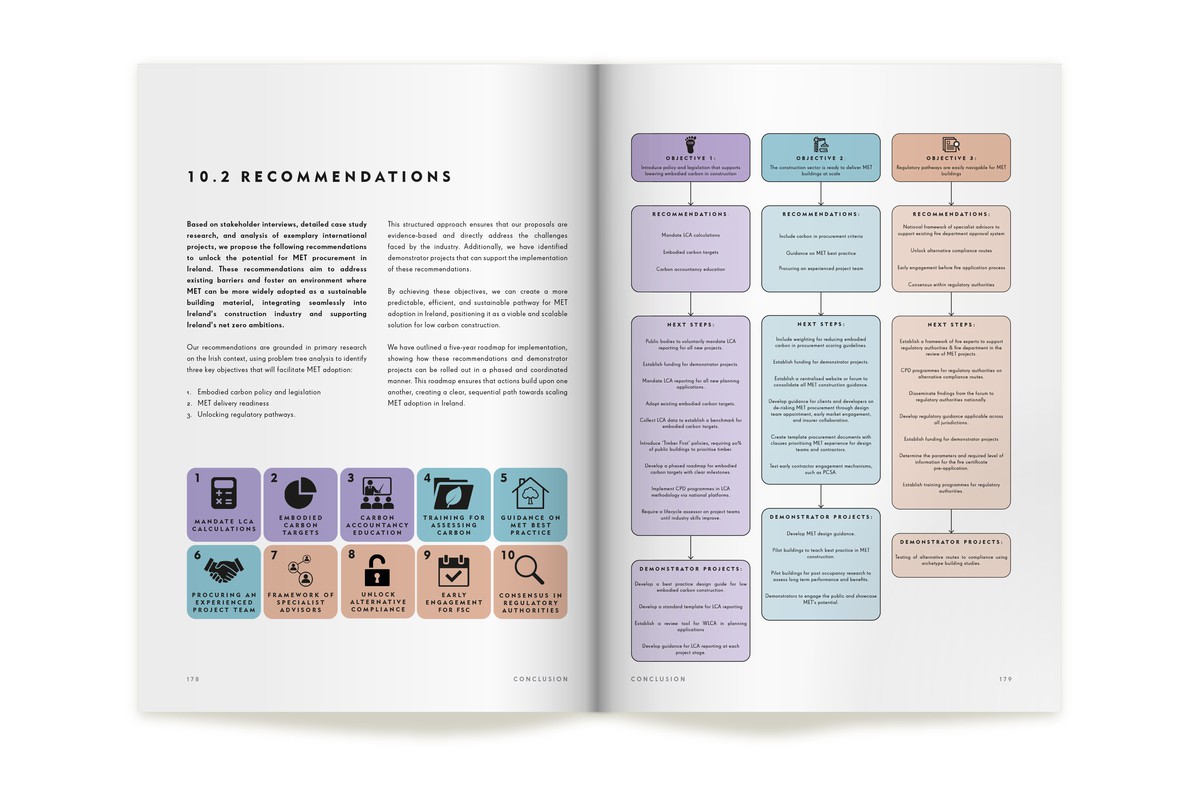
Drawing on international best practice, the report sets out a roadmap of ten recommendations, including the use of demonstrator projects to test approaches, build evidence and overcome barriers.
Together, these measures provide a pathway to making MET a mainstream construction material in Ireland - supporting climate and housing targets while strengthening the domestic timber industry and delivering long-term environmental and economic benefits.
Read the full report here